Isn't church social media just chasing the latest fad?
During a recent branding review, someone in the church shared an honest opinion with me. They said:
“The Christianity brand dwarfs a church’s individual branding. The same way you don’t care about the shop’s branding if you’re just going in for a Coke.”
They went on to say that working on the church's brand, website and social media felt like chasing the latest fad.
I'm really glad they said it out loud, because I know they're not alone. Plenty of faithful, thoughtful people feel the same way, and some of what sits behind it is right. The gospel doesn't need a logo. People come to faith through people, prayer and the work of the Holy Spirit, not through a nicely designed Instagram grid. And most churches have limited time, money and volunteers, so anything that pulls attention from the things that matter most deserves a hard look.
So I want to take the challenge seriously. Here's why I still believe that a strategic approach to communications is a vital part of discipleship and mission today, and what the research says.
Most people aren't popping in for a Coke
The Coke analogy works when you already know exactly what you want, you trust the product, and any shop will do. That describes some Christians moving house and looking for a new church. It doesn't describe most of the people a church is hoping to reach.
The Talking Jesus 2022 research (Savanta ComRes for the Evangelical Alliance and partners, surveying around 4,000 UK adults) found that just 6% of UK adults are practising Christians. Only 53% of non-Christians say they know a practising Christian, down from 68% in 2015.
So for most people in your community, church isn't a familiar shop on the corner. They don't know what's inside, what happens on a Sunday, whether they'll be welcome, or whether there's anything there for them at all. They're not walking in for a Coke. They're standing outside, wondering whether to open the door.
The "Christianity brand" isn't doing the work we hope
The idea that the bigger brand carries the local church assumes that the bigger brand is a positive one. The same research suggests it often isn't.
When non-Christians in the Talking Jesus study described the church, the most common words were "hypocritical" (26%) and "narrow-minded" (26%), with "friendly" at 22%. But when they described a practising Christian they actually knew, the picture changed completely: 62% said "friendly", 50% "caring" and 33% "good-humoured".
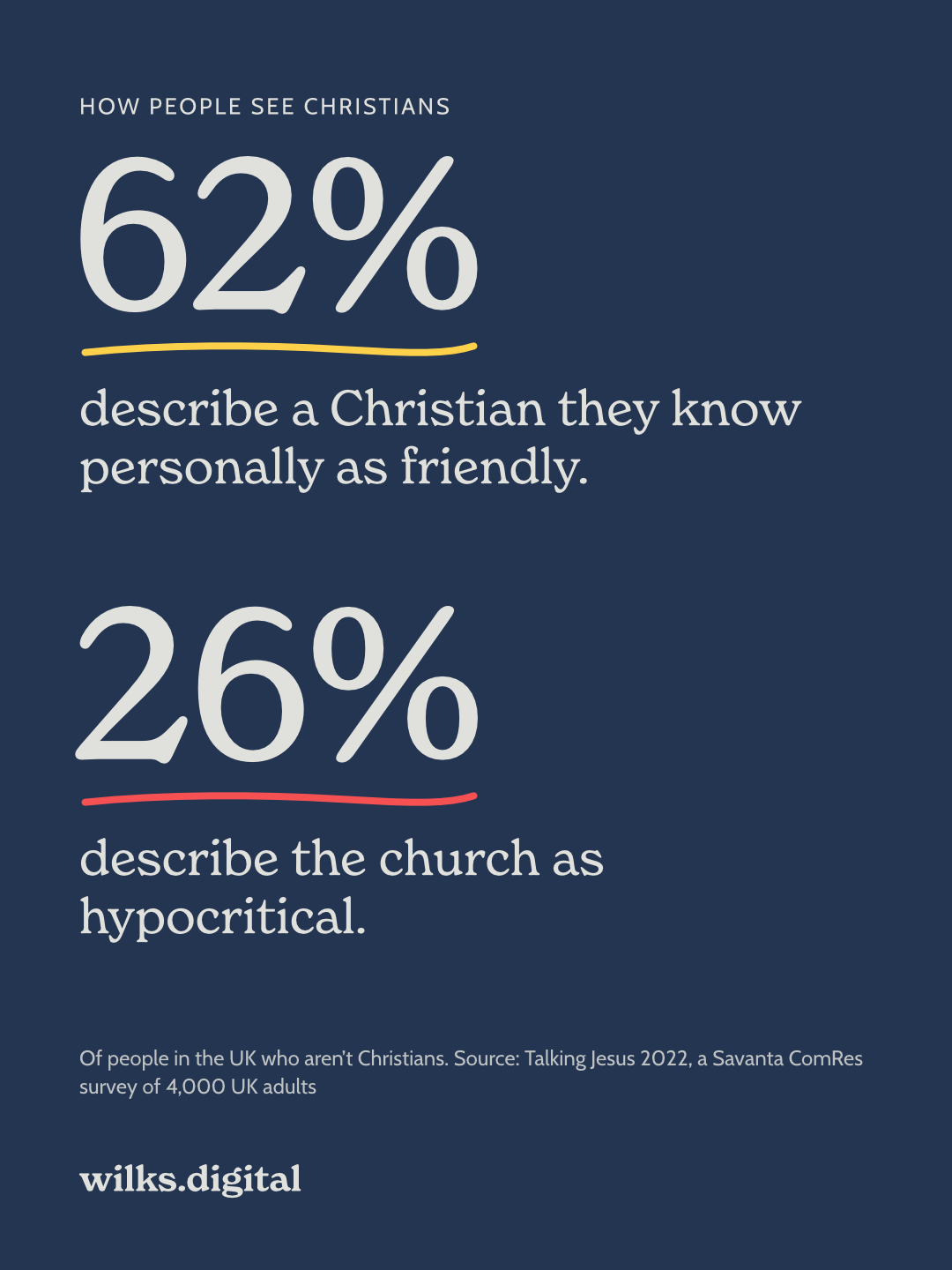
That gap matters. People think much more warmly about the real Christians they know than about "the church" in general. Your church's website and social media are one of the few places where someone who doesn't yet know any of your people can meet them: the faces, the stories, the welcome and the everyday kindness. Good communications don't compete with the Christian story. They help people see it lived out locally, by real people, in a place they could actually walk into this Sunday.
People look online first
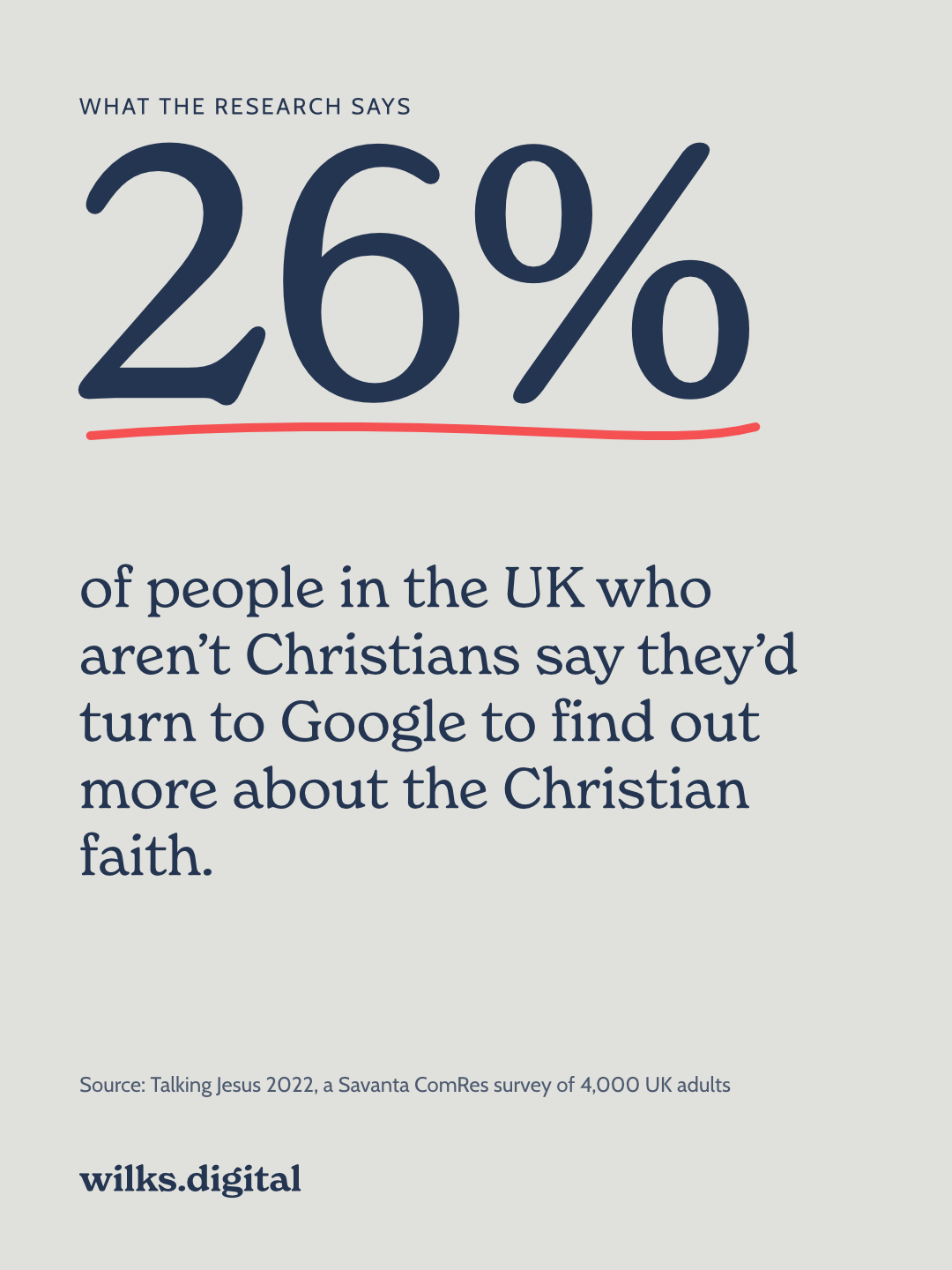
We don't have to guess where people go when they're curious. In the same UK study, the most common way non-Christians said they would find out more about the Christian faith was a Google search (26%), ahead of reading the Bible (22%) or going to a local church (22%). Among 18 to 24 year olds, 16% said they would search YouTube.
Other research points the same way:
UK adults now spend an average of four and a half hours online every day (Ofcom, Online Nation, December 2025), most of it on their phones.
The Church of England's church finder, A Church Near You, had 198.6 million page views in 2024, up 55% on the year before.
In the US, Pew Research found that 59% of adults under 30 who had looked for a new congregation used online searches to help, compared with 12% of those aged 65 and over.
Think about the 1.96 million people who went to a Church of England service on Christmas Eve or Christmas Day last year. Many of them will have searched for a time and a place first. What they found, or didn't find, shaped whether they came.
For many people, your website and social media are your church's front door. If the service time is hard to find, the photos are five years old, or the last post was in 2022, they'll draw conclusions before they ever meet anyone.
Is it a fad?
The particular apps will come and go. I'd be the first to say that a church doesn't need to be on every platform or jump on every trend. But the habit of looking things up online before we go anywhere new isn't a fad. It's simply how people live now.
The church has always used the communication tools of its day. Paul wrote letters. The Reformation travelled on the printing press. Generations of churches have relied on noticeboards, parish magazines and posters in the post office window. None of those were chasing fads. They were about meeting people where they already were, which is exactly what a website and social media do today.
This is about discipleship, too
Communications aren't only about attracting new people. They're part of how a church disciples the people it already has.
Talking Jesus found that online church services had played a part in 6% of practising Christians coming to faith, rising to 9% of 18 to 24 year olds, the same share as in-person services for that age group. Social media shared by people they knew had played a part for 8% of 18 to 24 year olds. In 2015, social media was mentioned by fewer than 1%.
When a church shares clear, honest, encouraging content, it gives its own members something they're happy to pass on to friends. It helps people stay connected between Sundays, pray for what's happening, and feel confident inviting someone. That's discipleship and mission working together.
Strategy, not slickness
When I talk about taking communications seriously, I don't mean expensive branding or a glossy, polished image. Some of the most effective church communications I've seen are simple, warm and made by volunteers with a phone.
What makes the difference is strategy: knowing who you're trying to reach, what you want them to know and do, and which few things your team can keep doing well. That's actually the opposite of chasing fads. A clear plan stops you reacting to every new idea and helps you spend limited time on what makes the biggest difference.
It also means looking at things through a newcomer's eyes. Can someone find your Sunday service time and address without scrolling? Do your photos show real people from your church? Would someone with no church background understand the words you use?
A free way to take an honest look
To help churches start that conversation, I've made a free Church Communications Health Check.
It's 20 honest questions across five areas:
Website
Social media
Video
Photography and design
Strategy and team
It takes about five minutes. At the end you'll see a score for each area, where your church is right now (Foundations, Growing or Flourishing), and practical next steps you can start on with the team you already have. Your answers stay private unless you choose to send them to me, and if you do, I'll reply by email with a few thoughts for your church.
It works really well at a staff or leadership meeting: take it together and see what you notice. It might also be a good way to open the conversation with someone who isn't sure all this matters.
If you'd like to talk about what your results mean for your church, tell me a little about your church and what you're hoping for. I'll reply by email, and we'll work out the next step together.
Sources
Evangelical Alliance, Hope Together and partners, Talking Jesus 2022. Savanta ComRes online survey of about 4,000 UK adults, January to April 2022. Figures used: 6% practising Christians (p.6); 53% of non-Christians know a practising Christian (p.14); Google 26%, Bible 22%, local church 22% (p.13); 16% of 18 to 24s would search YouTube (p.14); words used for Christians (p.17) and the church (p.18); online services and social media (p.33).
Ofcom, From apps to AI search: how the UK goes online in 2025 (Online Nation 2025), 10 December 2025.
Church of England, Surge in visits to church search website AChurchNearYou.com, 11 April 2025.
Church of England, Church attendance grows for fifth year in a row, 13 May 2026 (preliminary 2025 figures).
Pew Research Center, Choosing a New Church or House of Worship, 23 August 2016 (US data).